

Why We Still Return Every Call — Even the Ones That Go Nowhere

We get more calls now than we used to. More texts, more DMs, more “hey, got five minutes” voice memos. The easy thing to do, once you're busy enough, is to start sorting them before you ever pick up — this one sounds like it's going somewhere, that one probably isn't, answer the first kind first and let the second kind sit.
We don't sort them. We still return almost every call, including the ones we're fairly sure won't turn into anything. Not because we're more disciplined than anyone else, and not out of some rule we read in a book. We do it because access is the actual thing we're selling in a relationship-first business — not advice, not deals, access — and you can't be selectively accessible. The minute you start pre-judging which calls deserve a callback, you've quietly stopped being the people other people can reach. That's the whole asset, gone, one voicemail at a time.
The Year Every Call Was a Nobody Call
When we moved from the Los Angeles area to San Antonio in 2022, neither of us had a network here. Not a weak one — none. Every call that came in that first year looked exactly the same on paper: unknown number, no shared history, no obvious reason it would lead anywhere. We had no way to tell, from the outside of a ringing phone, which of those calls was a waste of twenty minutes and which one was about to matter.
So we did the only thing that actually worked: we returned all of them. Not because we had some system for separating signal from noise. Because we didn't have one, and pretending we did would have meant guessing wrong constantly and never knowing it.
Nobody owed us a callback in 2022, and we didn't owe anybody one either. Every relationship we have in Texas today started as a conversation with no history behind it and no guarantee in front of it. We couldn't afford to decide in advance which of those conversations was worth having, because “worth having” wasn't a judgment we were qualified to make yet. We hadn't earned the right to guess.
That year taught us something we didn't expect to still be using now that we're not starting from zero anymore. The habit you build when you have no way to filter is the same habit that works once you do have a way to filter — because the filter is never as good as it feels in the moment.

What Both of Us Learned Before We Ever Became “Michelle & Vin”
Here's the part that surprised us when we compared notes: we'd each already learned this lesson separately, years before we met.
Vin spent over 21 years in real estate, including running a transaction-coordination company — which is, functionally, a business built entirely on returning calls from agents, lenders, and buyers who mostly weren't calling about anything urgent. Michelle spent more than 13 years in entrepreneurship, with a run in staffing and recruiting, where the job is fielding call after call from candidates and clients, most of whom you'll never place or close. Different industries, same math: the overwhelming majority of calls in both of those careers didn't convert into anything you could point to. A small number did. And there was no way to tell which ones in advance.
That's the part we think gets missed. People assume the lesson is “answer your phone, good things happen.” That's not it. The actual lesson is narrower and less comfortable: the call that's about to matter sounds identical, in the moment, to the ninety-nine that won't. If you wait for a call that sounds important before you decide to show up for it, you will miss the ones that mattered, because they didn't announce themselves.
Why We Stopped Trying to Predict Which Calls Matter
We used to think we'd get better at this — that with enough experience, we'd develop a sixth sense for which callers to prioritize. We didn't, and we don't think anyone really does. What changed instead was that we stopped trying.
We can point to specific moments where our own guess would have been wrong. A call that sounded like a dead end on a Tuesday turned, months later, into an introduction neither side could have predicted on the first conversation. We're not naming names or specifics here — some of this is simply other people's stories to tell, not ours — but the shape of it has repeated often enough that we no longer trust our own first impression of a caller's usefulness. If we trusted it, we'd have hung up on people who later became some of our strongest relationships in this market.
There's real research behind why that instinct to pre-sort is usually wrong. A large study out of LinkedIn and MIT — led by LinkedIn researcher Karthik Rajkumar with MIT's Guillaume Saint-Jacques and Sinan Aral, published in the journal Science — tracked more than 20 million people over five years and used LinkedIn's own friend-recommendation algorithm to isolate which kind of connection actually produced new jobs. The people who ended up helping the most weren't close friends and weren't total strangers. They were the moderately distant contacts — people with relatively few mutual connections and low interaction frequency — the ones easiest to assume weren't worth following up with. As Scientific American summarized it, the study “finally shows that forging weak ties does indeed help people get new jobs.”
We're not in the job-search business, but the pattern tracks with what we've watched happen in ours for years. The contact who seems least likely to matter is disproportionately the one who ends up mattering. Not always. Just often enough that you can't afford to guess.
The Four Questions We Actually Ask
None of this means every call gets the same hour. We still have to protect our time, and “return every call” isn't the same as “give every caller unlimited access forever.” What we actually use, before deciding how much time a call gets, is four short questions.
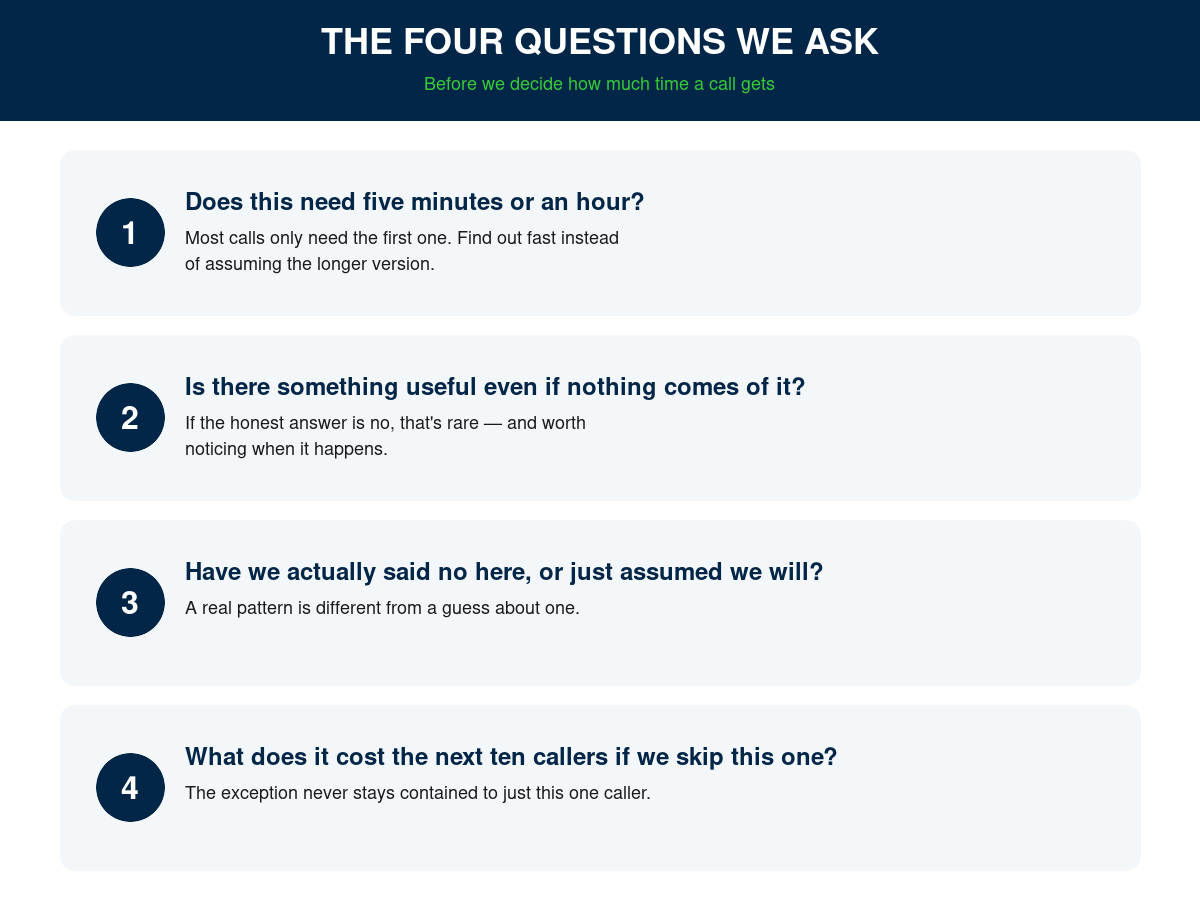
- Does this need five minutes or an hour? Most calls only need the first one. We find that out fast instead of assuming the longer version.
- Is there something useful we can say even if nothing comes of this? If the honest answer is no, that's rare — and worth noticing when it happens.
- Have we actually told this person no before, or are we just assuming we will? A real pattern is different from a guess about one.
- What does it cost the next ten callers if we start treating “I'm busy” as a reason to skip this one? Because the exception never stays contained to just this one caller.
Those four questions let us stay reachable without pretending every call deserves the same hour-long version of us. The point isn't heroic availability. It's refusing to let our own guess about a stranger's usefulness be the thing that decides whether they get a callback.
What This Actually Built
We didn't start the habit because we expected it to produce anything measurable. It's only looking backward that we can see what it did. More than 450 transactions came out of a network built almost entirely on calls that, at the time we took them, had no visible reason to matter. We became regional leaders for the South Texas SubTo and Gator community in early 2026, and Owners Club Captains that March — roles that exist because people kept calling and we kept showing up, long before either of us would have called it a “network.” We help host the OC Room inside Pace Morby's Owners Club now, a room built on the same idea: people showing up for each other without a transaction attached to every conversation.
None of that was the plan. It was the byproduct of a much smaller, much less impressive decision, repeated for years: pick up, call back, show up, even when the deal in front of you says there's nothing in it for either of you yet.
We're grateful for that, more than we expected to be. It would have been easy to credit the transactions and the titles to strategy, timing, or being good at the work. Some of that is real. But most of the actual door-opening came from people who had no obligation to call us back either, and did. We try to remember that every time we're tempted to let a call go to voicemail because the calendar looks full — somebody did the opposite for us when they had every reason not to.
Where This Leaves You
If you're building anything relationship-dependent — a real-estate business, a private-capital network, a community, a client base — you will be tempted to get more selective about your time as you get busier. That instinct isn't wrong about your time. It's wrong about which calls are worth it, because you don't actually know, and neither do we. The call that looks like nothing is statistically more likely to matter than your gut tells you it is.
You don't need our exact four questions. You need some version of a filter that scopes your time without letting you quietly decide, caller by caller, who's worth your effort before you've given them a real chance to show you.

If you've been sitting on a call you haven't returned because it doesn't look like it's going anywhere yet, return it anyway. And if the call you've been meaning to make is to us, here's where to start: book a conversation with us directly, find out what's happening in our community right now, or get our next lesson straight to your inbox through our newsletter.
Disclaimer: This content is provided for educational, informational, and entertainment purposes only. It is not legal, tax, accounting, investment, financial, or professional advice. Michelle and Vin are not acting as your attorney, CPA, financial advisor, or other licensed professional. Every situation is different. Conduct your own due diligence and consult your qualified professional team before making any business, real-estate, lending, investment, legal, tax, or financial decision. Nothing in this article is a promise or guarantee of results.