

Private Money vs Hard Money vs DSCR Loans
Real Estate Investing, Private Money Lending, Hard Money Loans, DSCR Loans
Private Money vs. Hard Money vs. DSCR Loans: Which Is Right for Your Next Real Estate Deal?
We’re Michelle & Vin, “the money couple” here in San Antonio, and if you’re a real estate investor staring at a juicy deal thinking, “Okay… but how do I actually fund this?” — this one’s for you.
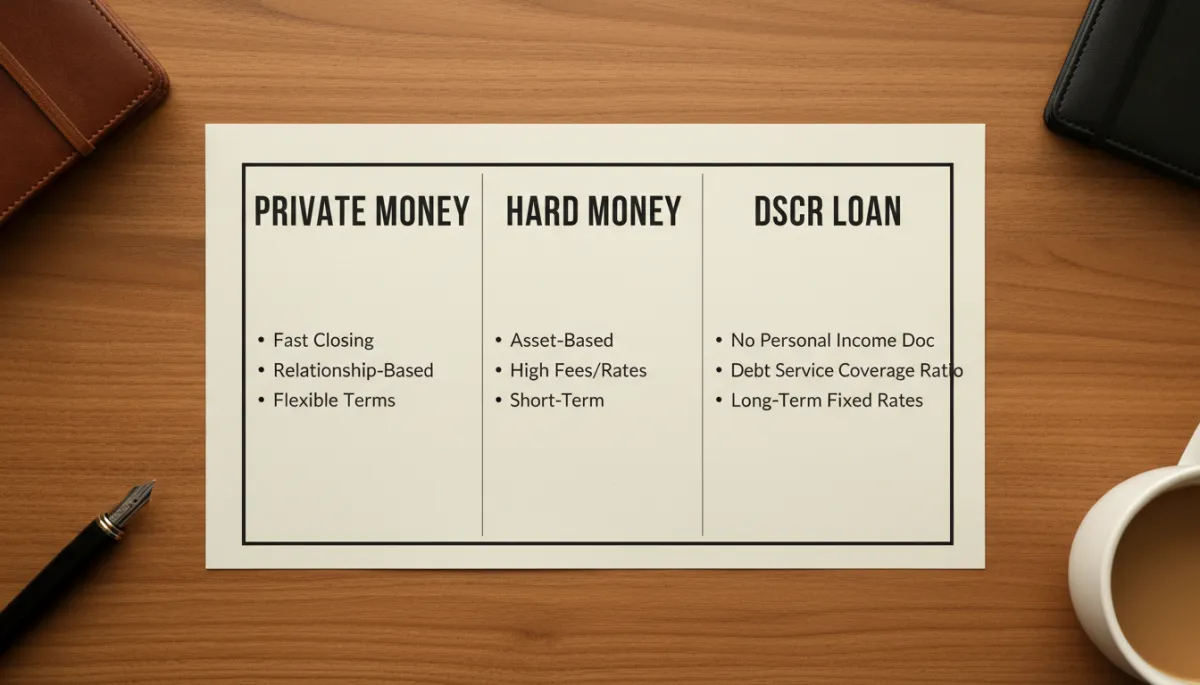
Fund Your Next Deal the Smart Way
Private Money vs. Hard Money vs. DSCR Loans Explained
Let’s Start With the Real Question: “Which Real Estate Loan Is Right for Me?”
You don’t wake up wanting a “product.” You wake up wanting to close a deal, grow your portfolio, and get paid. The loan is just the tool. Our job, as real estate financing nerds, is to match the right tool to the exact deal in front of you.
In Texas right now (mid‑2026), investors like you are mostly choosing between three buckets:
Private money lending – relationship‑driven, flexible capital from individuals or small funds
Hard money loans – professional, asset‑based lenders built for speed and short‑term projects
DSCR loans – long‑term loans for rentals, based on the property’s income, not your W‑2
We’ll walk you through how each works, when we use which, and how we think about private money lending for real estate investors versus hard money vs DSCR loans in real‑world deals across Texas.

The right funding partner can be worth more than a few points on rate.
Private Money Lending: Flexible Capital Backed by Relationships
When we say private money lending, we’re talking about loans funded by individuals or small groups — not banks, and not big institutional hard money shops. Think: a high‑net‑worth professional, a local investor, or a small fund that trusts your ability to execute a deal and wants a solid return.
How Private Money Typically Works in Texas (Right Now)
Across Texas in Q2 2026, private money and hard money loans are averaging around 10.14% interest, up from about 9.38% in Q1, with average loan‑to‑value (LTV) around 70–75% according to PrivateLenderLink and Lightning Docs data. San Antonio specifically is sitting near 10.07% with average loan sizes just over $300K.
In plain English: for most short‑term investment property financing in Texas, you should expect something in the 9–11% range for solid deals, higher if you need ultra‑fast, ultra‑flexible terms or the deal is hairier.
When Private Money Shines
You move fast. A private lender who knows you can sometimes fund in days, not weeks, with minimal paperwork.
Your deal is non‑standard. Weird property, title quirks, heavy rehab, rural location — a private money lender can be more “common sense” than box‑checking.
You value flexibility over the absolute lowest rate. Terms, draws, extensions, even profit‑sharing can be negotiated.
As a private money lender in Texas, we look at three things first: the deal, your track record, and your exit. If those make sense, we can usually build a structure that works for both of us.
💡 Pro Tip: Treat private money like a relationship, not a transaction. Communicate early, send updates, and protect your lender’s capital. That’s how you get invited back for the next deal.
Hard Money Loans: Fast, Asset‑Based, and Built for Fix‑and‑Flips
Hard money is basically private money that’s been turned into a business model. These are professional lenders who do nothing but short‑term real estate loans: fix and flip loans, bridge loans, new construction, and short‑term commercial plays.
What You Can Expect From Hard Money in 2026
In Texas right now, hard money lenders are typically quoting:
Rates: roughly 8.99%–11% for competitive programs in major metros like Houston and DFW, with some lenders going up to 13–15% for ultra‑fast or higher‑risk deals (Brazos Lending, Texas‑HardMoney.com, etc.).
Terms: usually 6–18 months — this is not your 30‑year forever loan, it’s a tool to acquire, rehab, and exit.
LTV: around 70–80% of purchase or ARV, depending on your experience and the deal.
When We Recommend Hard Money Over Private Money
You’re doing a classic flip. Buy distressed, rehab, sell in 6–12 months — this is what hard money was built for.
You want predictable systems. Draw schedules, underwriting, and timelines are standardized. Less “relationship risk.”
You’re okay trading a bit more paperwork for slightly better pricing than a one‑off high‑rate private lender.
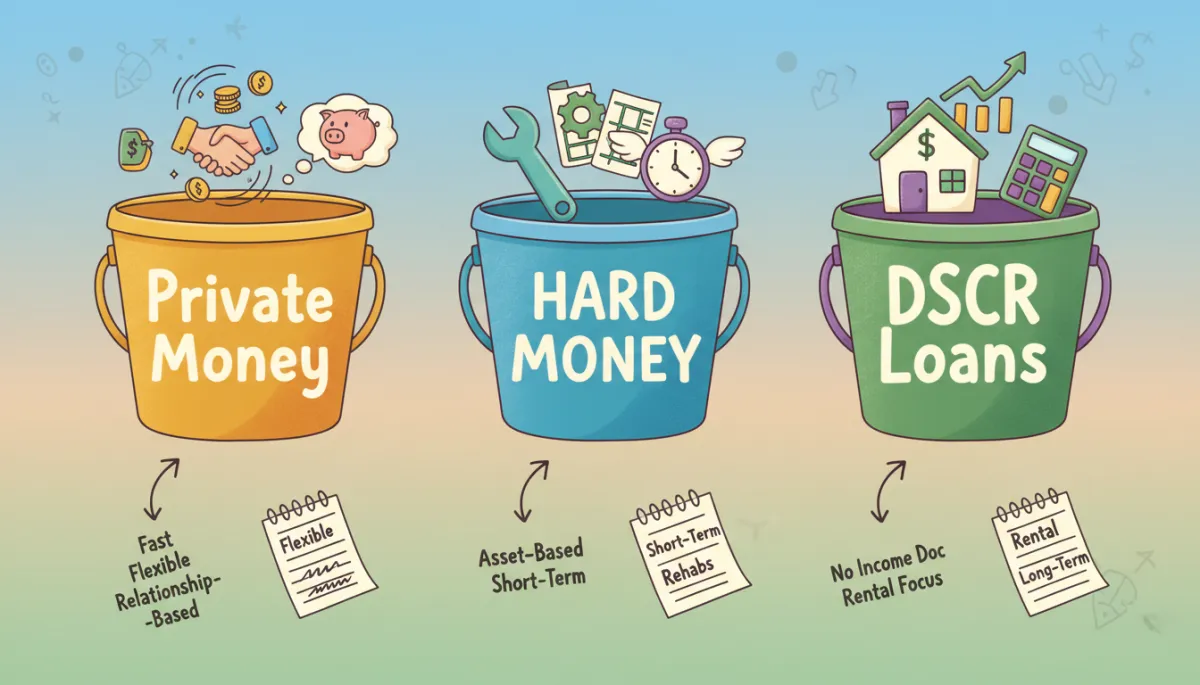
Seeing the three main loan types side by side makes the choice clearer.
DSCR Loans: Long‑Term Financing for Cash‑Flowing Rentals
Now let’s talk about DSCR loans, the go‑to move for the DSCR loan real estate investor building a rental portfolio. DSCR stands for Debt Service Coverage Ratio — fancy way of saying, “Does the rent comfortably cover the mortgage payment?”
The formula is simple: DSCR = Gross Monthly Rent ÷ PITIA (Principal, Interest, Taxes, Insurance, HOA) A DSCR of 1.00 means the rent exactly covers the payment. 1.25 means you’ve got a 25% cushion.
What DSCR Lenders Want to See in 2026
DSCR: Most programs like to see ≥ 1.0, with best pricing at ≥ 1.25. Sub‑1.0 deals exist but come with higher rates and lower LTVs.
Credit score: Minimums usually 620–660, with the best terms kicking in at 720+.
LTV: Up to 80–85% on purchases, lower on cash‑out refis (think 75–80%).
Reserves: Often 3–12 months of PITIA in the bank after closing, depending on risk profile.
Nationally, DSCR interest rates are sitting around a 6–8% range for strong files on 30‑year fixed loans, which lines up with what we’re seeing across lenders in 2026. That’s noticeably cheaper than short‑term hard money or private money because the lender is betting on long‑term, stable cash flow.
When DSCR Is the Clear Winner
You’re keeping the property as a rental. DSCR is built for buy‑and‑hold, not quick flips.
Your personal income is complicated. Self‑employed, multiple businesses, or you just don’t feel like sending your life story to an underwriter? DSCR relies primarily on the property’s income.
You want fixed, long‑term debt. 30‑year fixed, interest‑only options, portfolio flexibility — this is where DSCR loans shine.
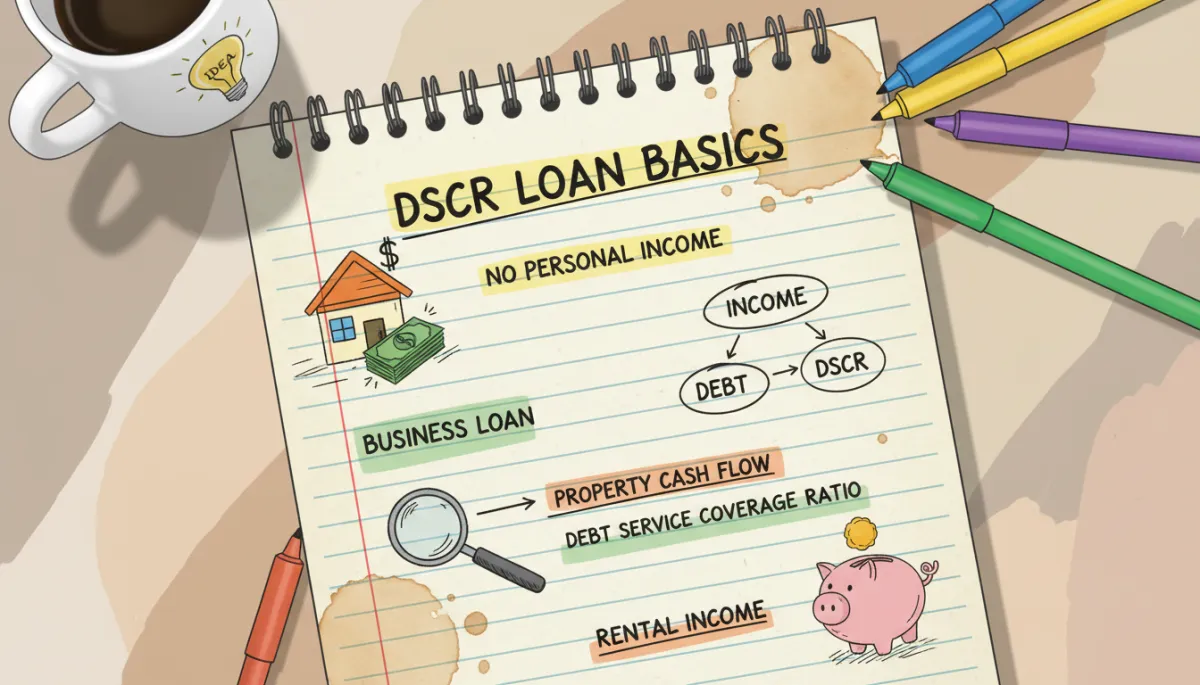
A DSCR of 1.25 or higher usually unlocks stronger rates and leverage.
Hard Money vs DSCR Loans: How We Decide in Real Life
We get asked about hard money vs DSCR loans almost daily, especially from investors who are transitioning from flipping into building a rental portfolio. Here’s how we break it down when we’re sitting with a client in San Antonio, Austin, or anywhere in Texas.
Feature Hard Money DSCR Loan Main Use Fix‑and‑flip, short‑term bridge, construction Long‑term rentals, small multifamily, portfolios Typical Term 6–18 months 15–30 years Rate Range (2026) ~9–13%+ depending on deal and speed ~6–8% for strong files Underwriting Focus Property value & exit strategy Property cash flow (DSCR) & borrower profile
Our rule of thumb: if you’re in and out quickly, use hard or private money. If you’re marrying the property and planning to hold, get a DSCR loan once the numbers support it.
Real‑World Example: Which Loan for Which Deal?
Let’s run through three simple scenarios we see all the time here in San Antonio and across Texas.
Heavy Fix‑and‑Flip in San Antonio – You’ve got a distressed property at 65% of ARV, needs a full gut. Timeline: 9 months. Exit: sell. We’re probably going hard money or private money with rehab funds built in. Speed and flexibility matter more than rate because your profit is in the spread, not the interest savings.
Turnkey Rental in Austin Suburb – Property is rent‑ready, strong rental comps, DSCR pencils at 1.25+. You plan to hold long‑term. This screams DSCR loan: 30‑year fixed, solid cash flow, and you’re not stuck refinancing every year.
New Construction Duplex in a Growing Texas Market – You’re building, then deciding whether to sell or rent. We might structure this as a private or hard money construction loan, then refi into a DSCR loan once leased up, locking in long‑term financing.

Pairing short-term rehab funding with a DSCR refi can stack equity and cash flow.
So… Which Real Estate Loan Is Right for You, Right Now?
If you’re still asking, “Which real estate loan is right for me?” here’s the simple decision filter we walk our investor friends through:
What’s your exit? Flip, refinance, or hold forever? Your exit almost always tells us which bucket to start with.
How fast do you need to close? “I need this done in a week” usually means private or hard money. DSCR takes a bit more underwriting.
What does the property look like today? Heavy rehab or weird property? Lean private or hard. Clean, rent‑ready? DSCR is in play.
What’s your DSCR? If rent easily covers payments (1.25+), we’re almost always mapping a DSCR strategy somewhere in the plan.
📌 Key Takeaway: Don’t start with “What rate can I get?” Start with “What’s my strategy and exit?” Then pick the loan that best supports that plan — even if it’s a bit more expensive on paper.
Ready to Talk Through Your Next Deal With Us?
We’re Michelle & Vin, based right here in San Antonio, and we live and breathe real estate investing and creative financing. Whether you’re eyeing a flip on the East Side, a new build outside Boerne, or a small multifamily in Houston, we can help you figure out the smartest way to fund it.
As a private money lender in Texas who also understands hard money, DSCR loans, bridge loans, GAP funding, and commercial loans, we’re not here to push one product. We’re here to help you pick the right capital stack for the deal you’re actually doing — today, in this market, with these numbers.
If you’ve got a deal on your screen right now and you’re wondering how to structure the funding, send it over. We’ll walk you through:
Whether private money, hard money, or a DSCR loan fits best — or a combo
What realistic rates and terms look like in Texas right now
How to structure your exit so you’re not stuck scrambling at maturity
You don’t have to guess. You just have to ask. Reach out to us, Michelle & Vin, and let’s make sure your next deal is funded smart, not just funded.

The right funding strategy turns good deals into repeatable wins.
Private Money vs. Hard Money vs. DSCR Loans for Real Estate Investors | Michelle & Vin, The Money Couple
Michelle & Vin, San Antonio’s “money couple,” break down private money lending, hard money loans, and DSCR loans so real estate investors can decide which loan is right for their next deal in Texas.
Disclaimer: This content is provided for educational, informational, and entertainment purposes only. It is not legal, tax, accounting, investment, financial, or professional advice. Michelle and Vin are not acting as your attorney, CPA, financial advisor, or other licensed professional. Every situation is different. Conduct your own due diligence and consult your qualified professional team before making any business, real-estate, lending, investment, legal, tax, or financial decision. Nothing in this article is a promise or guarantee of results.