

EMD Loans in San Antonio: How Investors Fund Earnest Money Without Tying Up Cash
EMD Loans in San Antonio: How Investors Fund Earnest Money Without Tying Up Cash

Picture this. It's a Tuesday morning, you've just spotted a deal in San Antonio that pencils out beautifully, and the seller's agent says the offer window closes at 5 p.m. You're ready. The financing is lined up. There's just one tiny problem: your cash is parked in another project, and the earnest money is due in a few days.
We've seen this movie more times than we can count, and we're here to tell you the ending doesn't have to be "sorry, we lost the deal." That's where EMD loans come in. Today we're breaking down what they are, when they're smart, when they're not, and what to ask before you sign anything.
What Is an EMD Loan, Really?
EMD stands for earnest money deposit. It's the good-faith money a buyer puts down to show the seller they're serious. An EMD loan is a short-term loan that covers that deposit for you, so you can get under contract without pulling cash out of your reserves or another deal.
Think of it as a bridge for the first few days of a transaction. The funds usually go straight to the title company, and the loan gets paid back at closing (or when the deposit is returned to you, if the deal doesn't go through). It's not a long-term financing product. It's a tool built for speed and for keeping your money working elsewhere.
And yes, we know what you're thinking: "Why would I borrow money for a deposit that comes back to me at closing?" Fair question. Hold that thought, because the answer is all about liquidity.

The Texas Twist: Earnest Money vs. Option Fee
If you invest in San Antonio, you already know Texas contracts have their own personality. Two numbers show up early in most deals, and people mix them up constantly:
- Earnest money: Goes to the title company, sits in escrow, and is credited toward your purchase at closing. Under the standard Texas contract it's usually due within a few days of the contract's effective date.
- Option fee: Paid to the seller for the right to terminate during the option period. It's generally not refundable, and it's separate from the earnest money.
Why does this matter? Because when you're stacking offers or running multiple deals at once, those two payments add up quickly. Always confirm the exact amounts and deadlines in your own contract with your title company and attorney. We're financing people, not your lawyer, and we like to stay in our lane.
When an EMD Loan Actually Makes Sense
We don't recommend an EMD loan for every deal. If you have idle cash and the deal is rock solid, just use your cash. But here are the situations where this tool earns its keep:
1. You're chasing multiple offers at once
Serious investors don't wait for one deal to close before making the next offer. If you have three contracts going, that's three deposits. Covering them with short-term funds lets you stay active without draining your reserves.
2. Your cash is temporarily locked up
Maybe a flip hasn't sold yet, or a refinance is still in underwriting. Your money is coming back, just not by Friday. An EMD loan covers the gap.
3. You want a bigger deposit to stand out
In a competitive market, a stronger earnest money amount can make your offer look more serious. Borrowing it lets you compete harder without risking your operating cash.
4. You're a wholesaler or doing transactional deals
If you're assigning contracts or running double closings, deposits are a cost of doing business. Keeping that cost lean helps your margins and your sleep.
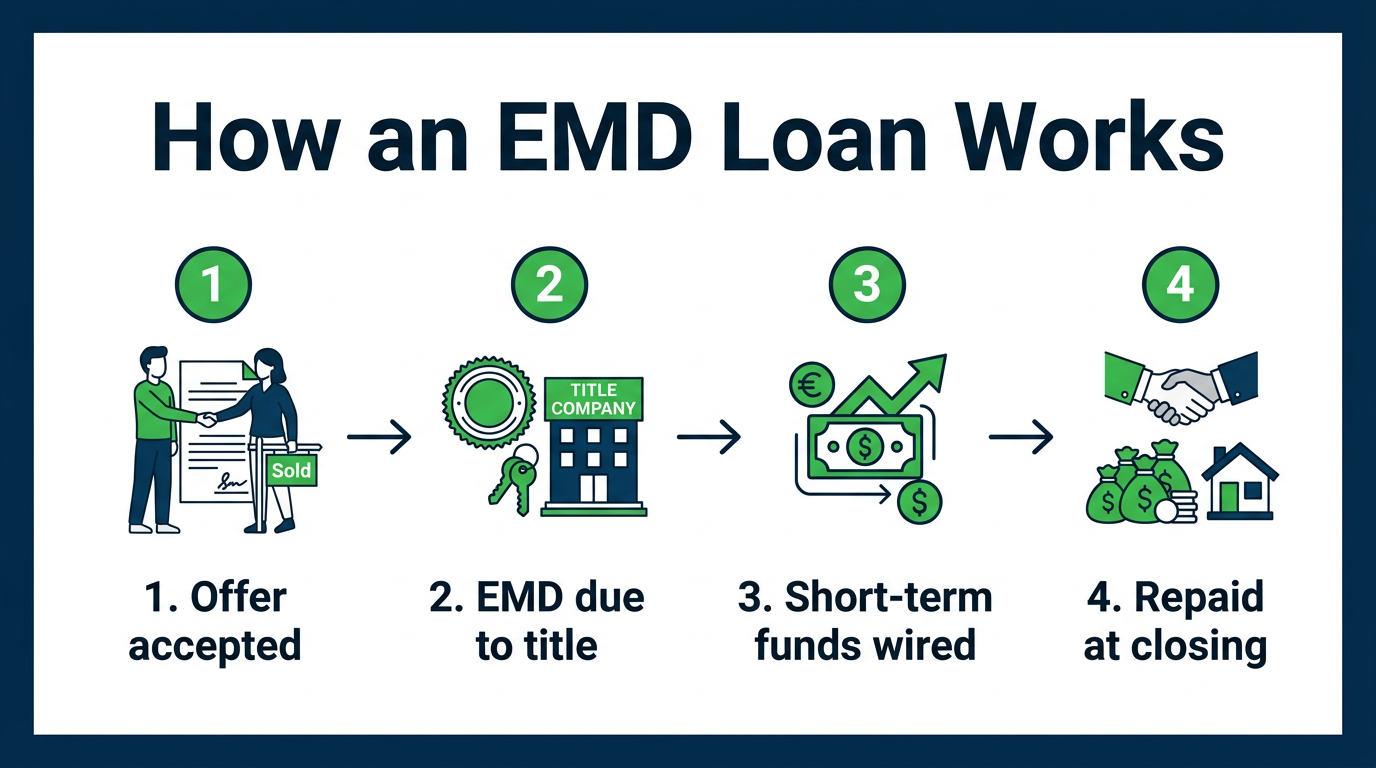
How the Process Works, Step by Step
- Offer accepted. You're under contract and the clock starts ticking on your deposit deadline.
- Share the details. Your lender looks at the contract, the property, and your plan for the deal. Expect to send the purchase agreement and title company info.
- Funds are wired. Once approved, the money goes to the title company so your deposit lands on time.
- Repayment. The loan is typically paid off at closing from the deal's proceeds, or from the returned deposit if the contract terminates properly.
The whole point is speed. A good lender can move in days, not weeks, because the loan is short and the paper trail is simple.
What Do EMD Loans Cost, and What Can Go Wrong?
Here's where we put on our straight-talk hats. Short-term, fast money usually costs more than a traditional loan, and that's the trade-off. Pricing varies by lender and by deal, and it's often structured as a flat fee or a percentage rather than a long-term interest rate. Always ask for the total dollar cost to you, not just the headline rate.
Now the risks, because we'd rather you hear them from us:
- Your deposit can be at risk. If you cancel outside the allowed windows in your contract, the seller may be entitled to keep the earnest money. You'd still owe the loan.
- Weak deals stay weak. Borrowing the deposit doesn't fix a shaky property or a deal you haven't underwritten. If the numbers don't work, walk away during your option period.
- Stacking costs can sneak up on you. A fee here and a fee there is fine on one deal. Across ten deals, it matters. Track it like any other expense.
A Simple Example (Numbers Are Illustrative)
Let's make this concrete with round numbers, not a promise of any specific terms. Say you're buying a $250,000 duplex near the Southside, and the earnest money is $2,500. You also have a rehab project that's consuming most of your available cash until it sells in a few weeks.
Without an EMD loan, you either drain your reserves or pass on the duplex. With one, the $2,500 is wired to the title company on time, you use your option period to do inspections and confirm your numbers, and the deposit loan is repaid at closing. If your final-loan approval goes through (a DSCR loan is common for rentals like this), you close, and the deposit is credited toward your purchase.
The cost of that short-term funding is small compared to the profit on a good deal. But if you skip your due diligence and the deal falls apart in the wrong window, that same $2,500 is the price of the lesson. That's why we always say: the loan doesn't make the deal, the deal makes the loan.
Five Questions to Ask Any EMD Lender
- What's the total cost in dollars, including every fee?
- How fast can funds reach the title company after I'm approved?
- How and when is the loan repaid, and what if the deal doesn't close?
- Do you require a credit pull, collateral, or a personal guarantee?
- Can you also fund the rest of the deal, like bridge, hard money, or DSCR financing, so I'm not juggling lenders?
That last one matters more than people realize. Fewer lenders means fewer surprises and a smoother closing day.
The Bottom Line
EMD loans are a small tool with a big job: they keep your cash flexible so you can say yes to more good deals. Used with discipline, they help you compete in San Antonio's fast-moving market without stretching your reserves thin. Used carelessly, they're just another way to lose a deposit.
The best investors we know treat liquidity like oxygen. They don't wait until they're gasping to think about it.

Have a deal with a deposit deadline coming up? Reach out to us, Michelle & Vin, and tell us what you're working on. We'll talk through your numbers like we would with a friend, and we'll tell you honestly if an EMD loan is the right move or if you're better off using your own cash. No pressure, just straight answers.
This article is for educational purposes only and isn't legal, tax, or financial advice. Terms, costs, and availability vary by deal and lender, so confirm contract details with your title company and attorney.