
DSCR Loans in San Antonio: Qualify With the Rent, Not Your W-2
Picture this: you find a solid three-bedroom rental on the northwest side of San Antonio. The numbers work. The tenant is already in place. Then the lender asks for two years of tax returns, and your CPA did what a good CPA does and wrote off everything legal. On paper, you barely made money. Deal dead.
We hear this story all the time. It's the reason we talk about DSCR loans constantly. They flip the question from "how much do you earn?" to "how much does the property earn?" If the rent covers the payment, you're in the conversation. Let's break down how it works, in plain English, with real math.
What Is a DSCR Loan, Really?
DSCR stands for debt service coverage ratio. Fancy name, simple idea: does the rental income cover the monthly cost of owning the property?
A DSCR loan is an investment-property mortgage that's underwritten mostly on the property's cash flow. That means:
- No W-2s or pay stubs
- No tax returns in most cases
- No debt-to-income ratio to wrestle with
- Closing in your personal name or in an LLC
It's built for investors who own rentals, not for people buying their primary home. If you're building a portfolio, or you're self-employed and your tax returns don't tell the real story, this is the tool we point to first.
The Math: How to Calculate Your DSCR
Here's the formula. Grab a calculator, it takes about thirty seconds.
DSCR = Monthly Rent ÷ Monthly PITIA
PITIA is principal, interest, taxes, insurance, and association dues (if there's an HOA). Everything it costs to hold the property each month, except repairs and vacancy.
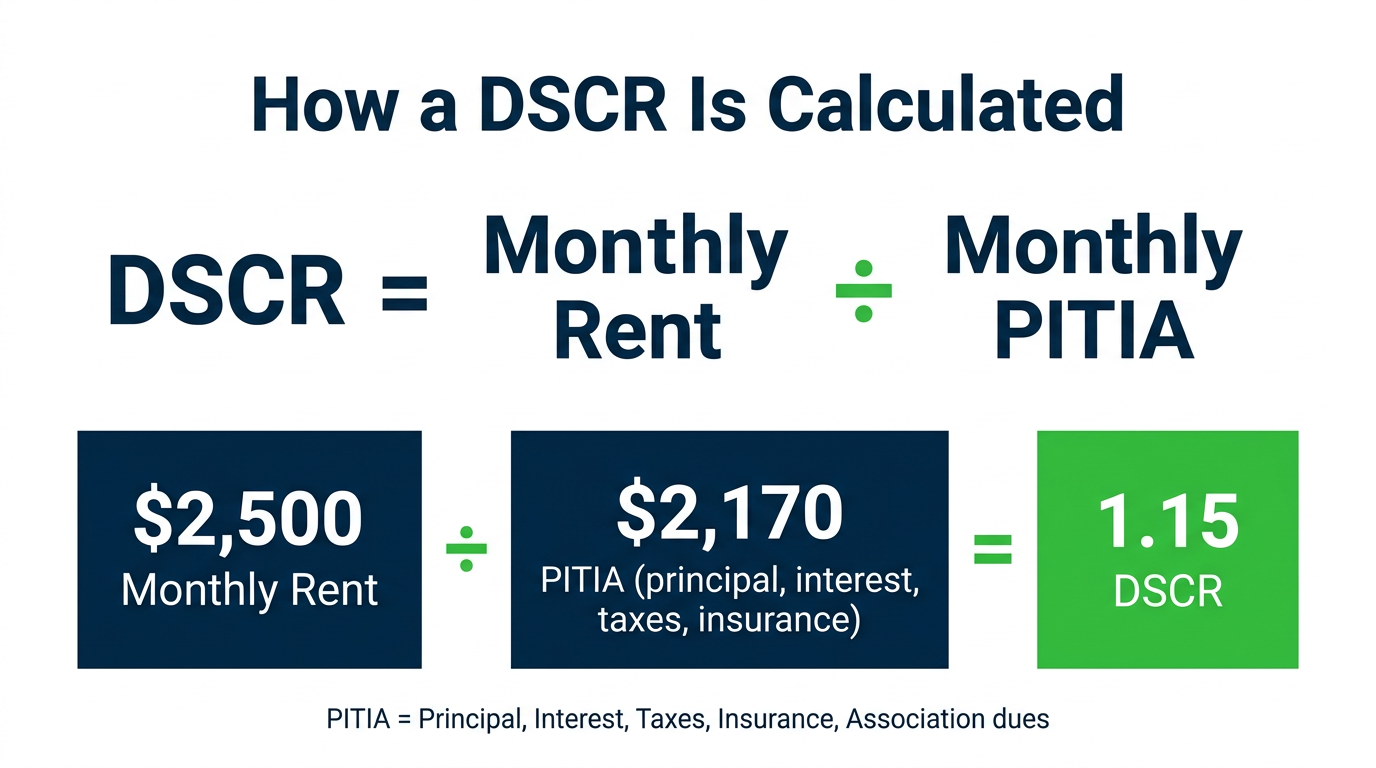
Using the example above: rent of $2,500 divided by a PITIA of $2,170 gives you a 1.15 DSCR. Here's how we got that $2,170 on a $285,000 purchase with 25% down:
- Principal and interest on a $213,750 loan at 7.25% for 30 years: about $1,458
- Property taxes (we used roughly 2.2% of value, which is realistic for much of Bexar County): about $522
- Insurance: about $190
That 7.25% is a placeholder so you can follow the math. Rates move constantly, so please don't quote us on it next month.
How to read the result:
- Above 1.0: the rent covers the payment. Most lenders are happy.
- Exactly 1.0: break-even. Some lenders will still work with it.
- Below 1.0: the rent doesn't cover the payment. A few programs allow it, usually with more money down and a higher rate.
Pro tip: a stronger DSCR often earns you a better rate. A 1.25 will usually get a friendlier price than a 1.05.
What This Looks Like in the Real World
Most of the investors we work with in San Antonio aren't Wall Street types. They're teachers with a side hustle, contractors, nurses, couples buying their third rental. A lot of them are self-employed, and that's where DSCR loans shine.

Take a typical situation. You own a landscaping business. Your income is real, but your deductions are big, so your tax return shows modest profit. A conventional lender looks at that return and says no. A DSCR lender looks at the rental's lease and says, "Show me the rent." Same investor, same property, totally different outcome.
It's also a great fit when you're scaling. Conventional loans cap out at a certain number of financed properties, and each new loan adds to your debt-to-income. With DSCR loans, each property stands on its own two legs.
What DSCR Lenders Actually Check
"No tax returns" does not mean "no requirements." We'd be doing you a disservice if we pretended otherwise. Here's what's typically on the checklist:
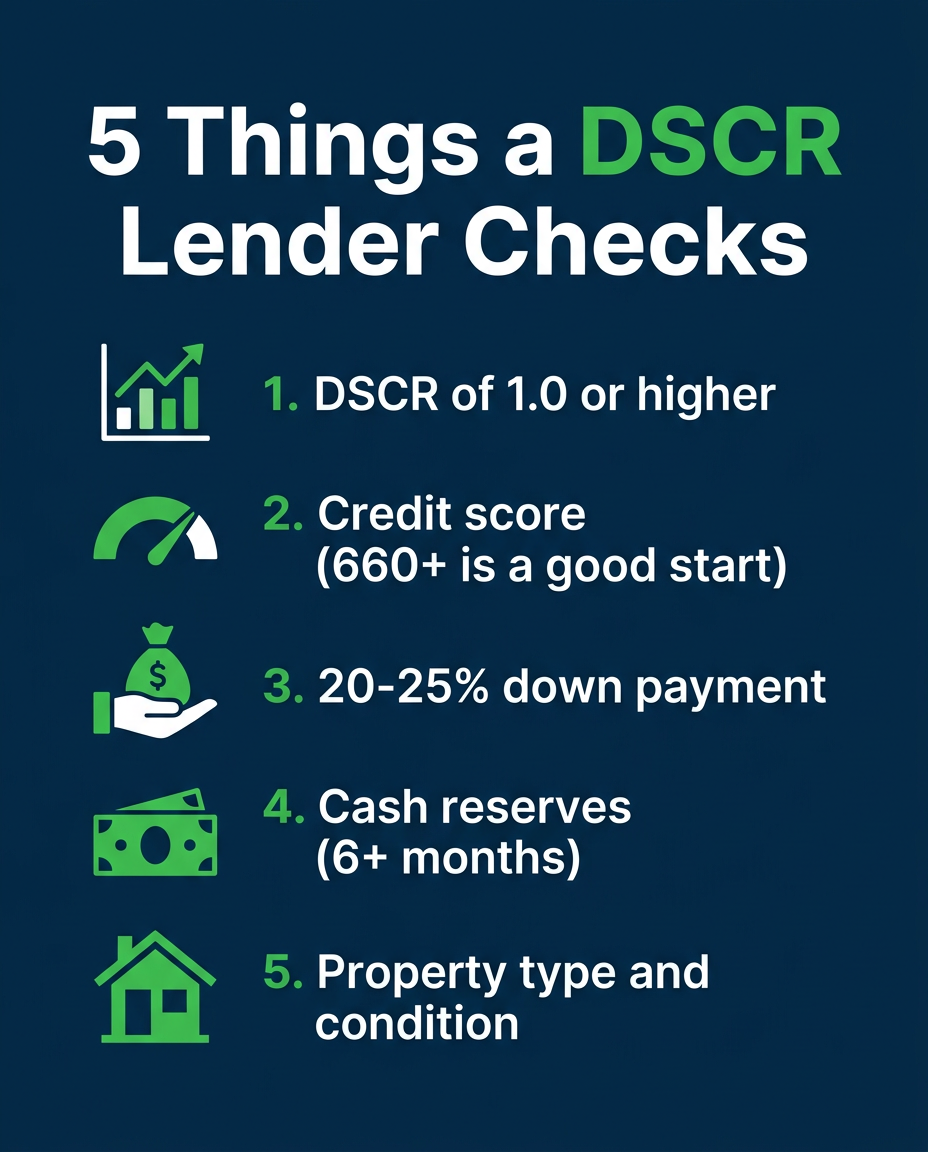
- The DSCR itself. 1.0 or higher is the sweet spot for most programs.
- Your credit score. Many lenders start around 660, and the best pricing goes to higher scores.
- Your down payment. Expect roughly 20 to 25 percent on a purchase.
- Cash reserves. Lenders often want to see several months of payments sitting in the bank after closing. We tell clients to plan for six.
- The property. Single-family homes, small multifamily, and condos are common. Condition matters, since a rental that's not rent-ready is hard to underwrite.
On rent, lenders usually use either your signed lease or a market rent estimate from an appraisal, whichever the program allows. If your lease is below market, that can work against you.
DSCR Loans vs. Conventional Loans
Neither one is "better." They're different tools, and the right pick depends on your deal.
- Documentation: DSCR is light. Conventional wants the full paper trail.
- Rate: Conventional is usually cheaper. DSCR loans typically run higher because the lender is taking on more flexibility.
- Speed: DSCR deals often close faster, since there's less paperwork to chase.
- Scaling: DSCR is friendlier when you already have several financed properties.
- Entity ownership: DSCR loans commonly allow closing in an LLC. Conventional generally doesn't.
Our rule of thumb: if you have clean W-2 income and a single rental, price out a conventional loan first. If you're self-employed, growing a portfolio, or buying in an LLC, DSCR deserves a serious look.
The Fine Print Nobody Wants to Read (But You Should)
We love DSCR loans, and we still want you going in with open eyes:
- Prepayment penalties are common. A typical structure steps down over several years. If you plan to sell or refinance early, ask about it up front.
- The rate is usually higher. Run your cash flow at the real rate, not the one you hope to get.
- Taxes and insurance are real. Texas has no state income tax, but property taxes and insurance can take a big bite. Always use actual numbers, not guesses.
- Not every deal qualifies. Short-term rentals, vacant properties, and heavy rehabs follow different rules.
Mistakes We See Investors Make
- Forgetting the HOA. It's part of PITIA, so it lowers your ratio.
- Using the asking rent as fact. Pull real comps, then underwrite to what you can truly collect.
- Skipping reserves. You can have a great ratio and still get stalled because the bank balance is thin.
- Shopping only on rate. Fees, prepayment terms, and speed to close matter just as much.
- Waiting until you're under contract. Get your numbers checked first. It saves a lot of stress.
A Quick Example Scenario
Let's put it all together with the deal we've been walking through. It's an illustration, not a quote, but it shows how the pieces connect.
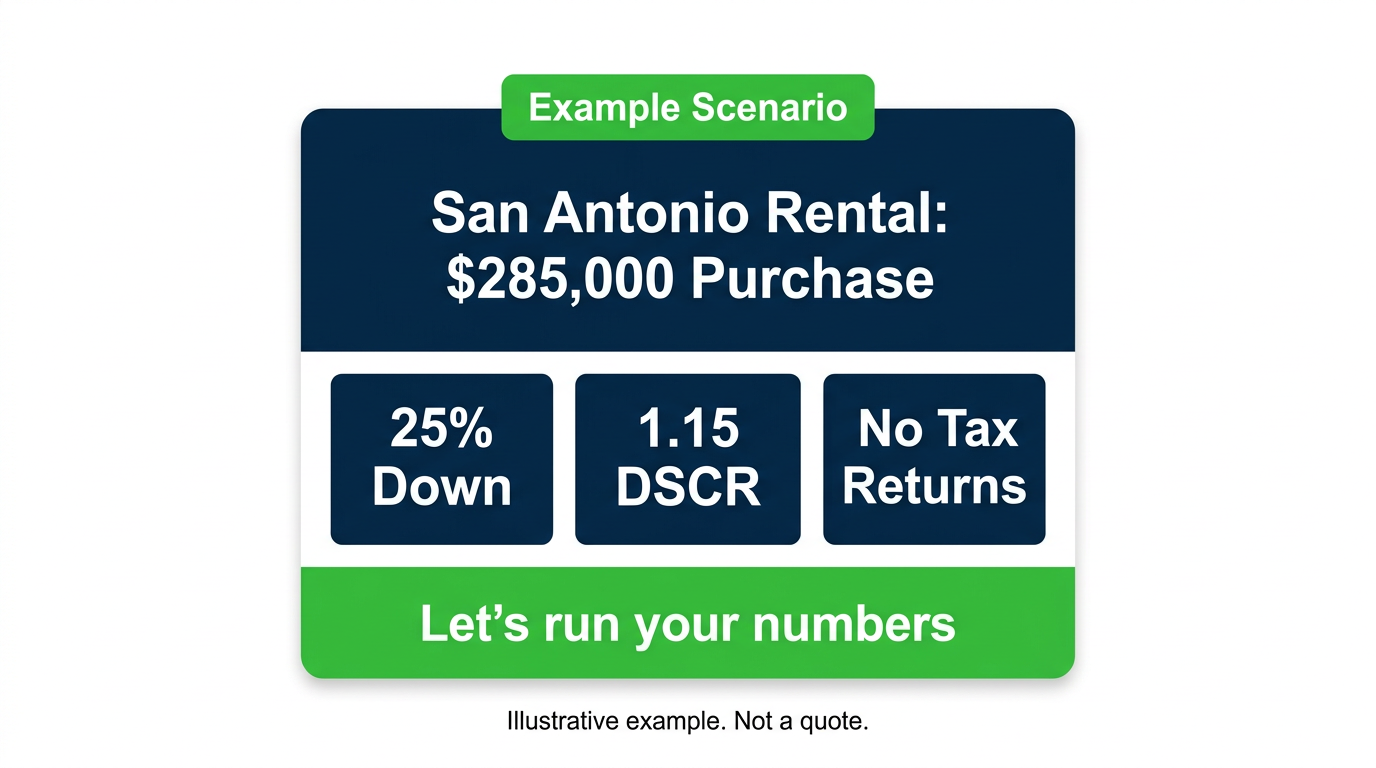
An investor buys a $285,000 rental with 25 percent down, which is $71,250. The home rents for $2,500, and the PITIA is $2,170. The DSCR comes out to 1.15, so the property passes the cash flow test without a single tax return. The monthly cushion is about $330 before repairs, vacancy, and management, which is why we always tell investors to keep that reserve fund healthy.
That's the whole idea: the property does the talking.
Quick Answers
Can I use a DSCR loan for my primary home? No. These are for investment properties.
Do I need an LLC? No, but many investors like closing in one. Talk to your attorney and CPA about what's right for you.
Can I refinance with a DSCR loan? Yes. Cash-out and rate-and-term refinances are common, and they're a popular way to pull equity out of a stabilized rental.
What if my DSCR is under 1.0? It's not automatically a no. Some programs exist, but expect a bigger down payment and a higher rate.
Let's Run Your Numbers
If you've got a deal in mind, or you're just wondering whether your next rental could pencil out, send us the address and the expected rent. We'll walk through the DSCR with you, show you where it lands, and tell you honestly if the deal works. No pressure, no jargon, just two people who really like helping investors win.
That's what we do, and we're based right here in San Antonio. Reach out to Michelle & Vin and let's see what your rent can do.
This post is for educational purposes only and isn't financial, legal, or tax advice. Rates, terms, and eligibility vary by lender and borrower, and the figures above are illustrative. Talk with a qualified professional about your situation.