

Commercial Loans for Real Estate Investors in San Antonio
Commercial Loans for Real Estate Investors in San Antonio: What Changes When You Cross the 5-Unit Line
You've been stacking duplexes and fourplexes. It's working. Now there's an 8-unit on the east side with your name practically written on it, and a lender just said the words, 'Well, that's a commercial loan.'
Don't panic. We've been right where you're standing, and the good news is that commercial lending isn't harder than residential. It's just different. Different questions, different math, different paperwork. Here's how we'd walk you through it over coffee.
Why the Fifth Unit Changes Everything
One to four units? That's residential land, even when you're an investor. Lenders look at you: your W-2s, your tax returns, your debt-to-income ratio, your credit.
Five units or more? You've crossed into commercial. Now the lender mostly stops asking, 'How much do you make?' and starts asking, 'How much does this building make?' The property becomes the borrower, and you become the person vouching for it.
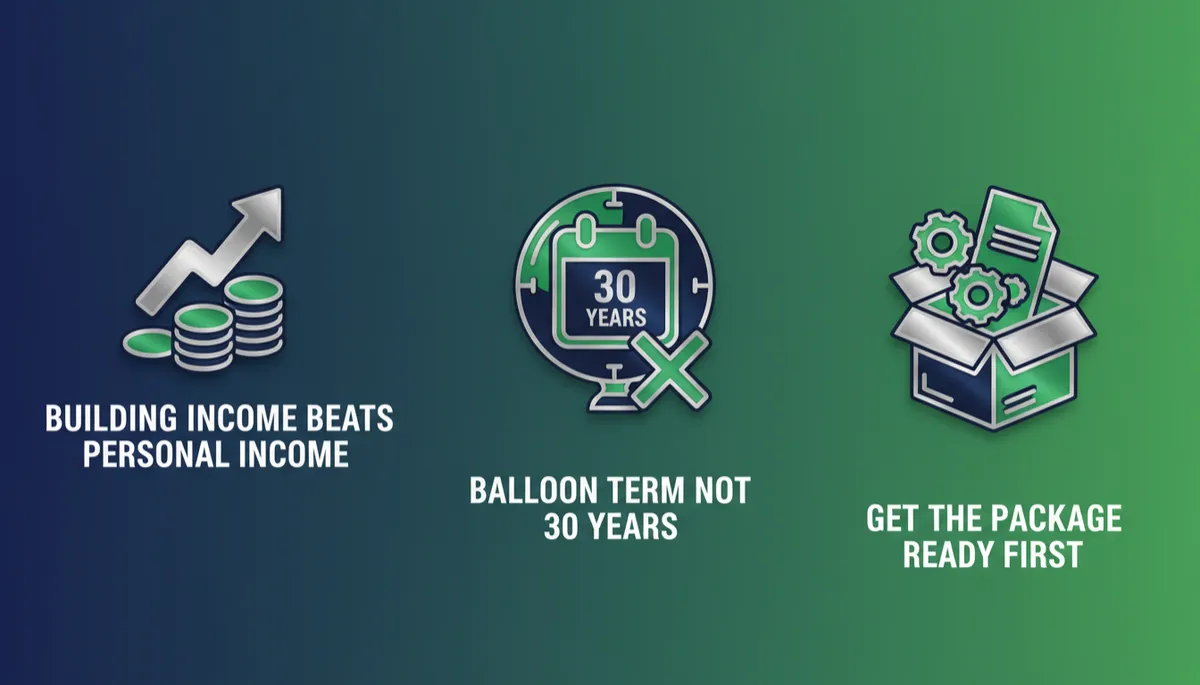
That's actually great news if you're self-employed, have a messy tax return, or already have a stack of mortgages on your personal credit. A strong building can carry the loan even when your personal profile is complicated. (Your finances still matter. Lenders just care about them second, not first.)
How a Commercial Lender Sees Your Deal
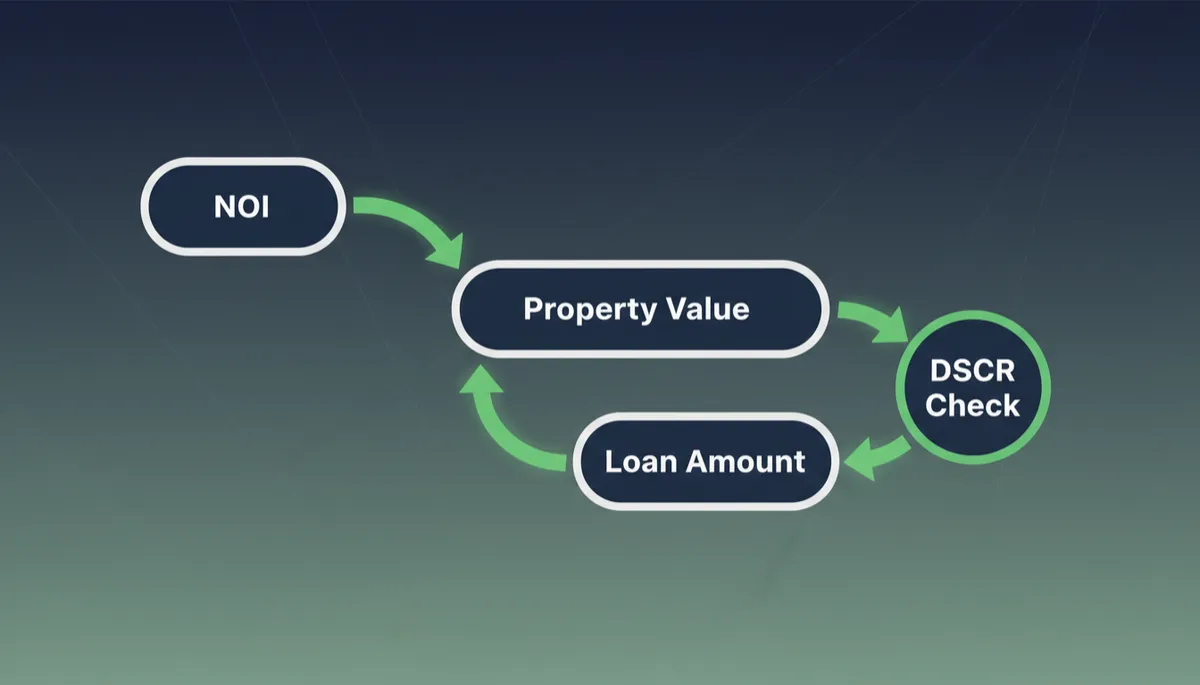
Three acronyms run this show: NOI, cap rate, and DSCR. Stay with us, it's simpler than it sounds.
- NOI (net operating income): the building's income minus its operating expenses, before any mortgage payment. Taxes, insurance, repairs, management, and owner-paid utilities all come out.
- Cap rate: the market's shorthand for what a building like this earns on its price. Value is roughly NOI divided by cap rate.
- DSCR (debt service coverage ratio): NOI divided by your yearly loan payments. It answers one question: can this building pay its own mortgage with room to spare?
Many commercial lenders want to see a DSCR somewhere around 1.20x to 1.35x on a stabilized property. That's a typical range, not a promise. Every lender sets its own bar.
And yes, a DSCR loan on a one-to-four unit rental and a commercial loan on a bigger building both lean on property income. They're cousins, not twins. Commercial loans usually come with balloon terms and a much closer look at the building's actual numbers.
A Worked Example (Illustrative Math, Not a Real Deal)
Let's say you're eyeing an 8-unit in San Antonio. Round numbers, because we like our math to survive a napkin:
- Rent: 8 units at $1,000 a month = $96,000 a year
- Other income (laundry, fees): $6,000
- Vacancy cushion (5%): about -$5,100
- Operating expenses: about -$37,900
- NOI: about $59,000
At a 6.5% cap rate, that building is worth around $908,000. A 75% loan-to-value would be roughly $680,000. Sounds great, right?
Now the lender runs the DSCR check. On a $680,000 loan at 7% with a 25-year amortization, you'd owe about $57,700 a year. Your NOI is $59,000. That's a DSCR of about 1.02x. Barely breathing.
If the lender wants 1.25x, the most yearly debt this building can support is about $47,200. That works out to a loan of around $556,000, not $680,000. You'd need roughly $350,000 in equity instead of $228,000.
This is the part nobody tells you: on commercial deals, DSCR usually sets your loan size, not LTV. The rate, the amortization, and the NOI all fight over how much you can borrow. Run this before you write an offer, not after. (Numbers are illustrative only. Real rates, terms, and cap rates vary by lender and market.)
What the Loan Itself Looks Like
Forget the 30-year fixed you're used to. Commercial loans have their own personality.
Balloon terms
You might get a 25 or 30-year amortization, but the loan comes due in 5, 7, or 10 years. That's the balloon. When it hits, you refinance or sell. Plan for that day on day one, because rates and values on that date aren't up to you.
Prepayment penalties
Many commercial loans charge you for paying off early. Some use a step-down (say 3-2-1), others use more complex structures. Read it before you sign, especially if your plan is to refinance in two years.
Recourse vs. non-recourse
Full recourse means you're personally on the hook if things go sideways. Non-recourse limits the lender to the property, with carve-outs for fraud and a few other bad behaviors. Smaller loans are usually recourse. Non-recourse tends to show up on larger, more stabilized deals.
Fees and reserves
Expect an origination fee, an appraisal, sometimes an environmental report, and sometimes escrowed reserves for taxes, insurance, or repairs. None of this is scary. It just belongs in your numbers upfront.
Where the Money Comes From
There isn't one 'commercial lender.' There are several lanes, and picking the right one matters as much as the rate.
- Local banks and credit unions: often the best pricing on stabilized deals, but they like relationships, deposits, and a clean story.
- Debt funds and commercial mortgage lenders: more flexible on borrower profile, usually a bit more expensive, and they care a lot about the property's numbers.
- Private and bridge lenders: great when the building isn't stabilized yet, needs work, or you need to close fast. You buy it, fix the occupancy, then refinance into longer-term debt.
That last lane is how a lot of small-balance commercial deals actually get done. You use short-term money to get the building to where the bank wants it, then you move it.
What to Have Ready Before You Call
Lenders move faster for people who show up organized. Our short list:
- The current rent roll and a trailing 12-month income and expense statement (T-12)
- Your entity documents (LLC paperwork, operating agreement)
- A personal financial statement and a real estate schedule showing what you own
- Your plan for the building, in plain English
- Proof of funds for the down payment and reserves
If you're newer to commercial, a short bio of your experience helps. Lenders are underwriting you as an operator, not just a borrower.
Mistakes We See All the Time
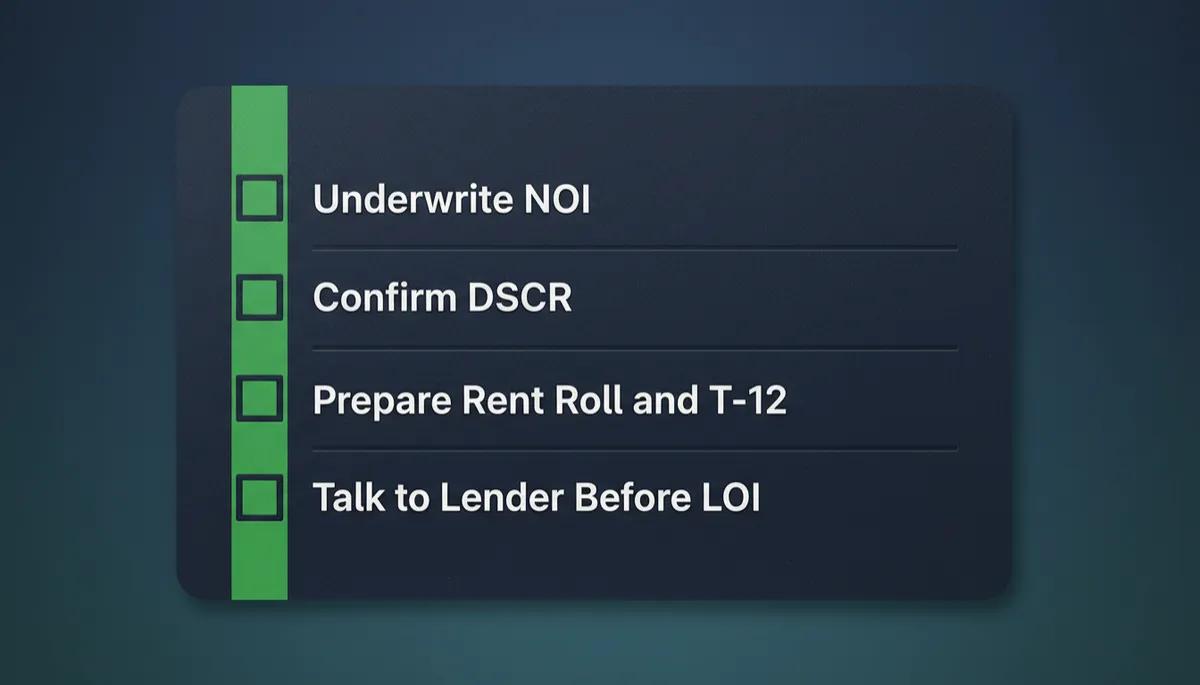
- Trusting the seller's numbers. A seller's pro forma is a marketing document. Underwrite your own NOI, with real taxes and real insurance.
- Forgetting that taxes reset. Texas property taxes can jump after a sale. Build that into your expenses.
- Shopping for rate and ignoring structure. A lower rate with a heavy prepay and a short balloon can cost you more than a slightly higher rate with room to breathe.
- Talking to the lender after the contract is signed. Have the financing conversation first. It saves you from a 'surprise, we'll lend you less' moment.
Key Takeaways
- At five units, the building's income, not yours, carries the loan.
- DSCR often sets your loan amount before LTV does.
- Expect balloon terms, prepay penalties, and a bigger paperwork stack.
- Pick the right lender lane for where your building is today.
- Run the numbers and talk to a lender before you make the offer.
Your Next Move
Crossing the 5-unit line is one of the best moves a growing investor can make, as long as you walk in with eyes open and numbers in hand. We've closed 450+ transactions and raised millions in private capital, and we still run the math before we fall in love with a building. You should too.
Got a deal on the table and not sure how the financing should look? Book a strategy call with us, tune in to our podcast, or follow along on our YouTube channel. We'd love to help you size it up.
This post is for educational purposes only and isn't financial, legal, or tax advice. Rates, terms, and requirements vary by lender and deal.