
BRRRR Method San Antonio: Financing the Refinance
You find a tired little San Antonio rental on the MLS at 9 a.m., run the numbers over coffee, and by lunch you're texting a hard money lender. Classic BRRRR move. We've all done some version of it.
Here's the part most investors skip, though: the financing stack you pick on day one decides whether you get your cash back at the refinance, or end up with a pile of money permanently trapped in the walls. In this post we're walking through the BRRRR method in San Antonio from the money side, because that's where these deals actually get made or broken. Grab a coffee. We'll keep it practical.

We're Michelle and Vin, the money couple. We've closed 450+ transactions, raised millions in private capital, and we hold mid-term rentals across the Sun Belt. We love a good BRRRR. We've also watched plenty of them go sideways at the refinance step, so consider this the post we wish somebody had handed us years ago.
BRRRR in San Antonio: the 30-second recap
BRRRR stands for:
- Buy a discounted property, usually one that needs work
- Rehab it to lift the value and the rent
- Rent it to a solid tenant at a real market rate
- Refinance into long-term debt (very often a DSCR loan)
- Repeat with the cash you pulled back out
That last R is the whole point. The strategy only works if the refinance hands back enough capital to do the next deal. Everything else is just a really long way to buy a rental.
Step one: buy and rehab with short-term money
Most distressed San Antonio properties won't qualify for a regular 30-year loan on day one. So investors typically use hard money or private money to buy and fix the property.
Just so you've got a feel, here's what short-term money often looks like (these are example ranges, not a quote):
- A 6 to 12 month term with interest-only payments
- Rates in the neighborhood of 10 to 12 percent, plus 2 to 3 points at closing
- Funding based on a percentage of purchase plus rehab, sometimes tied to the after-repair value (ARV)
Private money tends to be more flexible and relationship-driven. We've raised a lot of it, and the pattern never changes: every lender wants to know exactly how they get paid back. If you can't explain your exit in two sentences, you're not ready to take their money yet.

Step two: make the rent numbers honest
In a DSCR refinance, the lender cares a lot less about your W-2 and a lot more about whether the property's rent covers the new payment. So your rent estimate is not a place for optimism.
Pull real comps. Talk to a local property manager. Then underwrite the deal with a rent that's a little lower than the number you're hoping for. When we look at deals with our investors, we run a conservative rent and a realistic rent, never the unicorn number from the prettiest listing on the block.

Step three: the DSCR cash-out refinance
This is where it all comes together. A DSCR cash-out refinance swaps your short-term loan for long-term debt that's underwritten mostly on the property's debt service coverage ratio: rent compared to the full monthly payment.
A few things worth knowing (again, example figures; every lender is different):
- Loan-to-value: many DSCR lenders cap an investment-property cash-out refinance somewhere around 70 to 75 percent of the appraised value.
- Minimum DSCR: often around 1.0 to 1.2, meaning the rent needs to cover principal, interest, taxes, insurance and any HOA dues by that margin.
- Taxes matter. Texas has no state income tax, but property taxes are not small, and they go straight into that ratio. Leave them out of your model and your DSCR will look great right up until the lender runs it.
- Prepayment penalties. Plenty of DSCR loans carry one. Ask about it before you fall in love with the rate.
Texas cash-out rules vs. investor loans
Texas has strict rules for cash-out loans on a primary residence (the famous Section 50(a)(6) rules). Those limit how much equity you can pull from your own homestead and add special closing requirements. If you've heard "Texas cash-out is complicated," that's usually what people mean.
Here's the good news for BRRRR investors: those homestead rules are about owner-occupied homes. Your San Antonio rental is an investment property, so you're in a different part of the rulebook. You still have LTV limits and underwriting standards, but you're not playing by the homestead rules. Confirm details with your lender and title company, but don't let the homestead horror stories scare you off.
Seasoning: how long before you can refinance?
Most DSCR lenders want a seasoning period between your purchase and the cash-out refinance. It varies a lot, and somewhere in the 3 to 6 month range is common. Some lenders will only use your purchase price plus documented rehab costs until the property has seasoned longer, which can shrink your cash-out in a hurry.
Why do we care? Because every month of seasoning is another month you're paying a hard money rate. If your rehab drags or your tenant takes longer to land, that timeline eats your profit. This is exactly why we say it all the time: fund the exit before you fund the entry. Talk to a DSCR lender early, not 60 days before your hard money balloon comes due.
The appraisal gap and "money left in the deal"
This is the moment BRRRR investors either smile or swear. Let's use a clearly hypothetical example.
- Purchase price: $170,000
- Rehab budget: $40,000
- Closing, holding and soft costs: $15,000
Your all-in cost is about $225,000. Say you used a $200,000 hard money loan plus $25,000 of your own cash. After the rehab, the property appraises at $260,000, and your DSCR lender offers 75 percent LTV.
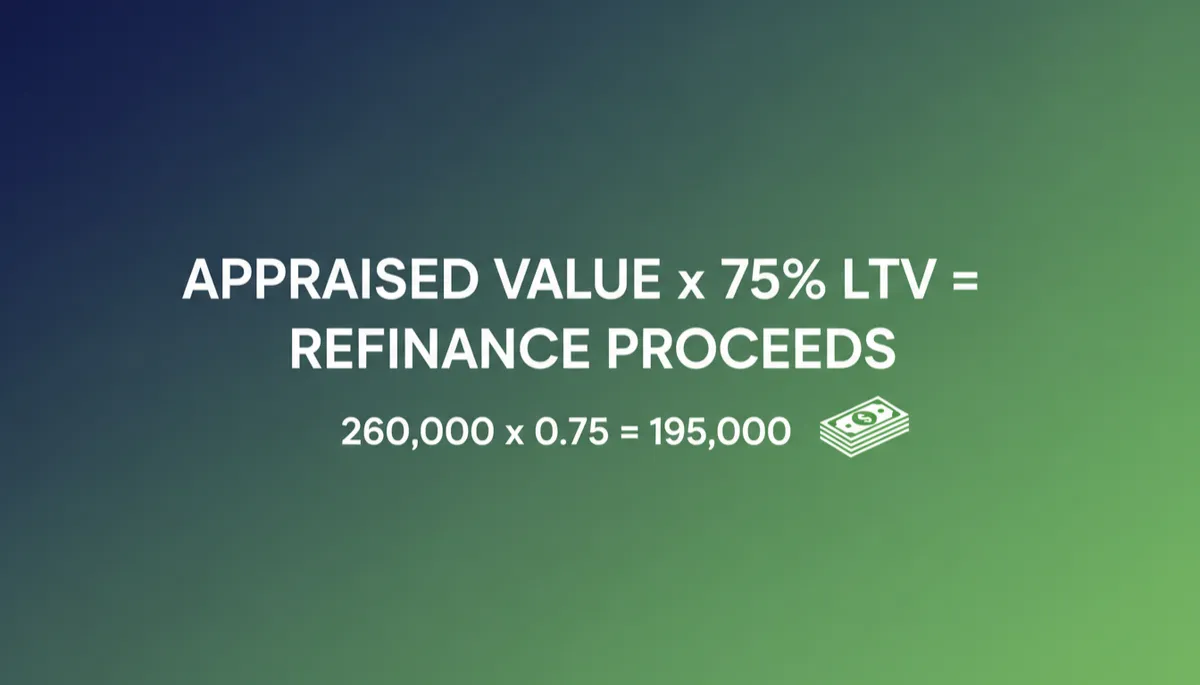
$260,000 x 75% = $195,000. That pays off the hard money loan with a few thousand to spare at the table, and you have roughly $30,000 left in the deal ($225,000 minus $195,000). Not bad. Plenty of investors are happy to own a stabilized San Antonio rental with $30,000 of their own capital in it, as long as the cash flow is healthy. But if your goal was to be "all the way out," that number just told you otherwise.
What if the appraisal comes in light?
Now let's rerun it with a grumpy appraiser, a weak comp or a slightly softer market. The property appraises at $240,000 instead.
$240,000 x 75% = $180,000. Your hard money payoff is still $200,000, so you need about $20,000 in cash just to close, and you've got roughly $45,000 left in the deal. That's the moment a lot of investors realize the financing stack made or broke the deal, not the rehab.
The takeaway: appraised value x LTV = refinance proceeds. Compare that number to your all-in cost before you buy, using a conservative ARV, not the best-case one.
Four BRRRR financing mistakes we see in San Antonio
- Napkin underwriting. Running rents without modeling taxes, insurance and real DSCR lender terms.
- Ignoring seasoning. Taking a 6 month hard money loan when the refinance lender wants 6 months of ownership plus a rent history.
- Overestimating ARV. Using comps from a hotter pocket when your house sits on a busier street in a softer submarket.
- No Plan B. Assuming the refinance will be perfect, with zero room for a lower appraisal or a tighter LTV.
Plan B: hold, extend or bring a partner
If the refinance doesn't hit your ideal numbers, you still have options:
- Hold with more money left in. If the DSCR works and the property cash flows, accepting a bigger equity chunk isn't failure. It's a slower recycle, and you can revisit a cash-out refinance when rents or values rise.
- Extend the short-term loan. Some hard money and private lenders will extend for a fee, especially when you call early and tell them the truth. That buys time to season the property or wait for better comps.
- Bring in a partner. An equity partner can cover the cash gap in exchange for a share of the long-term cash flow and equity.
None of these is the dream scenario of "I got every dollar back." But serious investors plan for them up front. BRRRR is a financing strategy wrapped in a rehab project, not the other way around.

Our quick BRRRR financing checklist
Before we get excited about any BRRRR deal, we ask four questions:
- Does the all-in cost leave enough room under a conservative ARV?
- Do realistic rents cover the lender's minimum DSCR after taxes and insurance?
- Does the seasoning period line up with the rehab timeline and the hard money term?
- What's Plan B if the appraisal or LTV comes in light?
If you'd like a second set of eyes on your numbers, that's exactly the kind of conversation we have over coffee with investors all the time.
Quick FAQ
Is BRRRR dead in San Antonio?
Nope. It just rewards investors who buy better and underwrite tighter. The spread between your all-in cost and a realistic ARV matters more than any headline.
Do I have to use a DSCR loan for the refinance?
Not always. Some investors use conventional or portfolio loans, especially early on. DSCR loans are popular because they lean on the property's income instead of your personal debt-to-income ratio.
We're Michelle and Vin, the money couple, and we help San Antonio investors line up the right financing for the deal in front of them. If you've got a BRRRR in the works (or a funding question that's keeping you up at night), reach out and send us your numbers. Even if it's not a match for us, we'll tell you straight and point you in a better direction. 💚