

Bridge Loans for Texas Real Estate Investors
Real Estate, Bridge Loans, Texas Investing
Bridge Loans for Real Estate Investors in Texas: How to Close Your Next Deal Before Your Current Property Sells
SEO Meta Title: Bridge Loans for Texas Real Estate Investors: Close Your Next Deal Before Your Current Property Sells. SEO Meta Description: Bridge loans let Texas investors move fast — securing your next deal without waiting for a sale to close. Michelle & Vin break down how bridge loans work, what they cost, and when they beat every other financing option.

We’ve lost deals we still think about in the shower. You probably have too. The off-market fourplex with under-market rents. The clean little flip in a neighborhood you know like the back of your hand. You ran the numbers, you loved the upside… but your down payment was still sitting in the equity of a property that hadn’t sold yet.
By the time that sale finally closed, the deal you really wanted was gone. Someone else moved faster, and you were left saying, “If I’d just had 60–90 days of capital, that would’ve been my win.”
We’re Michelle & Vin — “the money couple” here in San Antonio. Between us, we’ve closed 450+ transactions and raised millions in private capital across Texas. And we can tell you: the investors who scale in this market don’t always have more money than you. They just know how to use bridge loans for real estate investors in Texas to unlock the equity they already have and move first when a deal hits their inbox.
What Is a Bridge Loan, Really?
Let’s strip out the jargon. A bridge loan is simply short-term bridge financing for real estate that helps you get from Point A to Point B without waiting for a sale, a refinance, or a bank committee to bless your life choices. In Texas, that usually looks like a 6–24 month, interest-only loan secured by the equity in a property you already own, or sometimes the property you’re buying — or both.
Instead of letting that equity sit there and smile at you on a spreadsheet, you use it to:
- Fund the down payment on your next deal, or
- Cover rehab and holding costs while you reposition an asset, or
- Buy before you sell — without writing “contingent on sale” on your offer.
The superpower of a bridge loan in Texas real estate is speed + flexibility. Private lenders and bridge lenders aren’t trying to be your 30-year mortgage. They’re there to give you a strong, fast “yes” so you can lock up the deal and then execute your plan: refinance, sell, or pay it off from another event. That payoff plan — your real estate bridge loan exit strategy — is everything. We ’ll come back to that.
How Bridge Loans Work in Practice (Walk Through a Real Scenario)
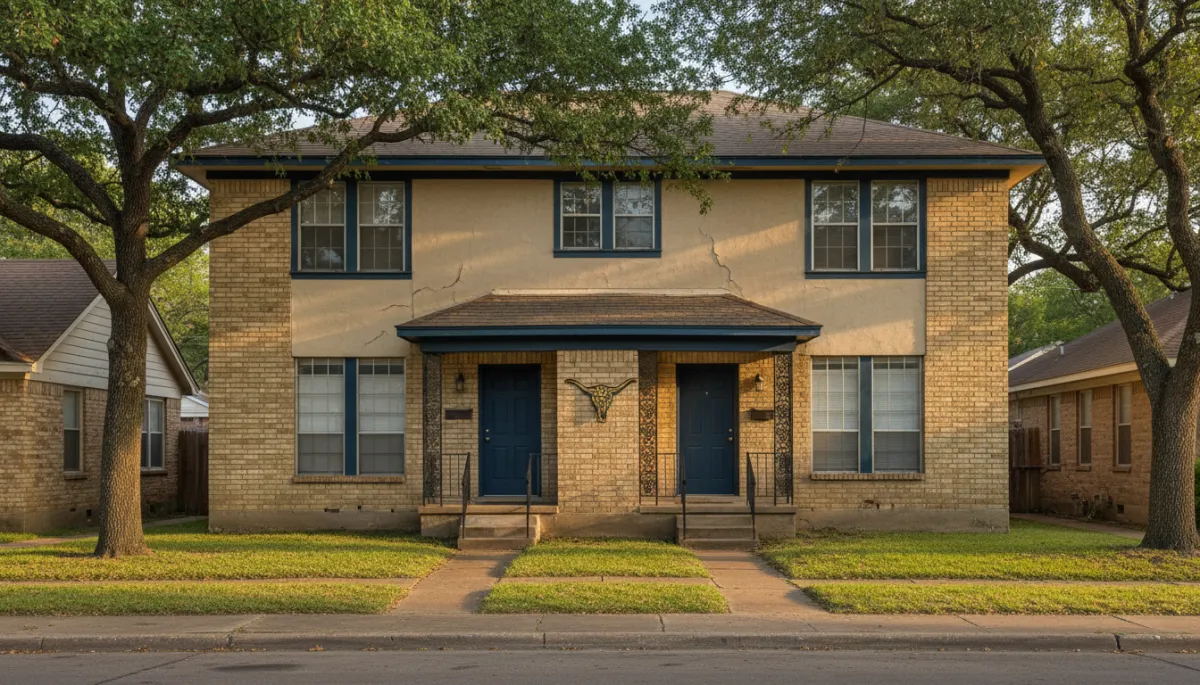
The best bridge loan deals are often ordinary-looking properties with hidden upside.
Let’s talk about a very Texas, very real example. Say you own a duplex in San Antonio worth around $280,000. Your current loan balance is about $160,000, so you’re sitting on roughly $120,000 in equity. Rents are solid, property’s clean, and you’re planning to sell it in the next 3–6 months to level up into a bigger asset.
Then you find it: a distressed fourplex for $210,000 a few miles away. Rents are way under market, there’s obvious cosmetic upside, and you know you can get it to a $320,000+ value with some rehab and better management. But… your down payment for the fourplex is trapped in the duplex that hasn’t sold yet. Classic investor problem.
Here’s where a bridge loan Texas real estate structure can save the deal:
- A bridge lender looks at your duplex, sees the equity, and offers a short-term bridge loan secured by that property (and possibly the new fourplex as well).
- They might lend up to 65–70% of the duplex’s value. On $280K, that’s around $182K–$196K total debt. Since you already owe $160K, that leaves $22K–$36K in new capital you can pull out — enough to cover the down payment and part of the rehab on the fourplex, depending on the deal structure.
- Alternatively, the bridge lender funds the entire fourplex purchase price (or close to it) using a cross-collateralized loan on both properties, leveraging the equity in the duplex as additional security.
You close on the fourplex now, stabilize it over 6–12 months, and then you execute your exit strategy:
- Option 1 – Sell the duplex: When the duplex sells, you use the proceeds to pay off the bridge loan, and then refinance the fourplex with long-term debt at a lower rate.
- Option 2 – Refi both: After you raise rents and clean up the fourplex, you refinance into a conventional or DSCR loan based on the new value and cash flow, pay off the bridge, and keep both properties if the numbers support it.
That’s how to use a bridge loan to buy before selling in a way that’s actually strategic — not reckless. You’re not borrowing to “figure it out later.” You’re borrowing against equity you already created, with a clear, written payoff plan and realistic timelines based on the current Texas market (where days-on-market are longer and price cuts are common, according to recent reports from Texas REALTORS® and TRERC).
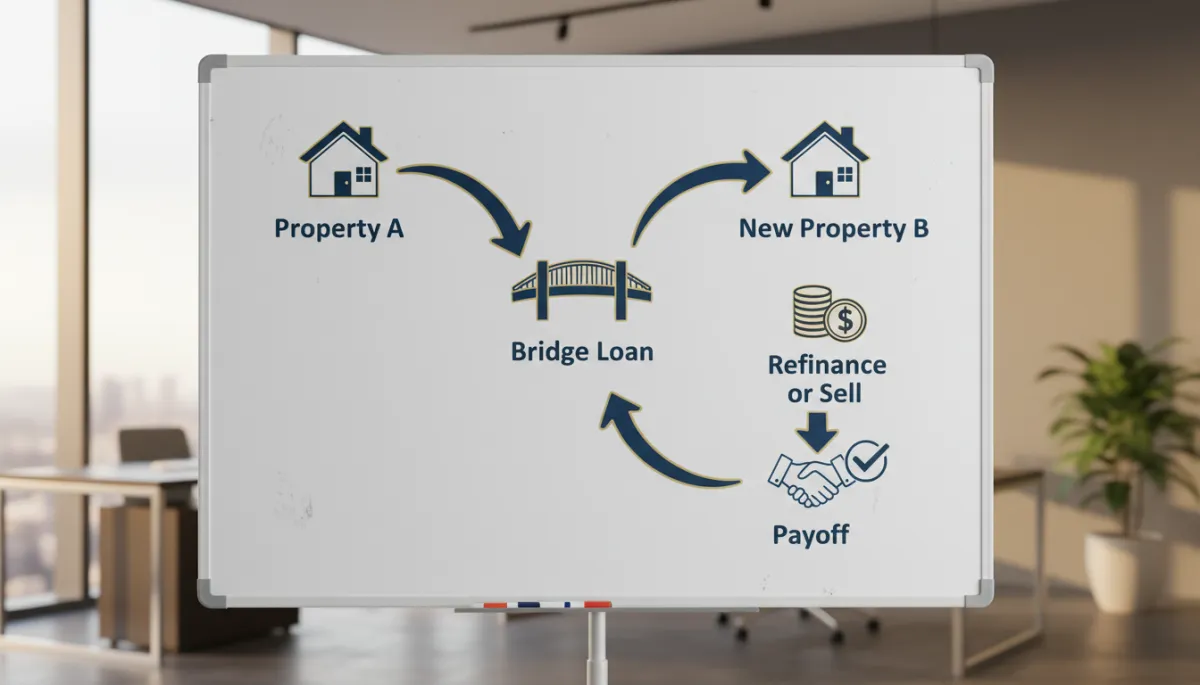
A solid exit strategy turns short-term bridge financing into a repeatable wealth-building system.
Bridge Loans vs. Hard Money vs. Gap Funding
We get this one a lot: “Isn’t a bridge loan just hard money?” Sort of, but not exactly. Here’s the quick breakdown for bridge loan vs hard money Texas investors:
| Tool | Best Use | Secured By | Key Idea |
|---|---|---|---|
| Bridge Loan | Buying next deal before current one sells; tapping equity quickly | Existing property equity (sometimes plus new deal) | You already own something with equity |
| Hard Money | Fix-and-flip, BRRRR, heavy rehab where value will jump | The new deal itself (asset-based) | You may not have another property; deal stands alone |
| Gap Funding | Covering the difference between your cash and what you need | Often second-lien or unsecured, depending on structure | Fills the last 5–20% of the capital stack |
In other words: bridge loans shine when you have equity tied up in an existing asset. Hard money shines when you’ve found a great deal but don’t have another property to leverage. Gap funding is literally the “gap” — the last slice between what your primary lender will give you and what you actually need to close. Understanding the gap financing bridge loan difference keeps you from stacking expensive money in the wrong order.
What Do Bridge Loans Actually Cost in Texas?

Paying a premium for speed makes sense when your equity and exit are dialed in.
We’re not going to sugarcoat it: bridge financing is not your cheapest money. It’s your fastest, most flexible money. Think of it as paying a premium for front-row seats to the deal, while everyone else is still in Ticketmaster purgatory waiting on bank approvals.
Based on recent 2026 data from sources like Lightning Docs and other private lender reports, bridge loan interest rates Texas are generally landing around the 9–13% interest-only range for most investor-focused deals, with some outliers higher or lower depending on risk and property type. Statewide averages have been hovering near 10% for short-term loans, which lines up with what we see in our own network of Texas lenders and private capital partners.
- Rates: Typically 9–13% interest-only; niche or higher-risk deals can hit the mid-teens, especially for heavy rehab or very small loans.
- Points (origination fees): Commonly 1–3 points (1–3% of the loan amount) paid at closing.
- LTV: Often 65–75% of current value or ARV, depending on whether it’s more of a pure bridge or a hybrid rehab/bridge structure.
- Terms: 6–24 months is typical; 12 months is very common for investors doing value-add or BRRRR plays.
If that sounds expensive compared to a 30-year fixed, good — it should. This is not forever money. It’s “grab the opportunity, create value, then replace it with cheaper capital” money. When you underwrite deals using realistic bridge costs and timelines, it becomes a tool, not a trap.
When a Bridge Loan Is the Smartest Move
So when does short-term bridge financing real estate actually make sense in Texas? Here are scenarios where we’ve seen it shine for investors we work with (and in our own portfolio):
- Inherited property with a ton of equity: You inherit a free-and-clear or low-leverage house in San Antonio, Dallas, or Houston. Instead of rushing a discount sale, you use a bridge loan to tap the equity, fund a value-add project, then sell or refinance once you’ve had time to plan intelligently.
- 1031 exchange with a brutal deadline: You’ve sold a property, identified your replacement, but timing is tight. A bridge loan can help you close on the new asset quickly while you clean up loose ends on the relinquished property or structure long-term financing without blowing your 1031 timeline.
- Off-market deals that won’t wait: Wholesaler calls you with a fourplex in an area you love. Seller wants a fast, clean close — no financing or sale contingencies. A bridge loan lets you say “yes” now, then refinance or sell something else later to pay it down.
- Portfolio investors scaling quickly: Maybe you’re rolling up several small properties into a bigger one. Bridge loans can help you consolidate, sequence closings, and avoid leaving equity idle while you wait on traditional underwriting.
- Airbnb / STR repositioning: You’re converting a long-term rental into a short-term rental near the River Walk, the Stockyards, or the coast. A bridge loan covers rehab, furnishings, and launch while you season income and then refi into a DSCR or portfolio loan once the numbers are proven.
How to Qualify (Without W2 Income)
If you’re self-employed, full-time investor, or your tax returns look like a professional sport called “deduct everything,” you’re exactly who bridge lenders and hard money shops in Texas are built for. Most bridge loan requirements no W2 look very different from bank underwriting. They’re usually asset-based, not “show-me-your-paystubs” based.
- Equity position: Lenders want to see real equity in the existing property (and sometimes some skin in the new deal). The more equity, the easier the approval and better the terms.
- Exit strategy clarity: This is king. How will you pay the bridge loan off — refinance, sale of which property, timeline, backup plan? If you can’t explain it on one page, it’s not ready yet.
- Experience & team: If you’re newer, a strong contractor, property manager, or mentor on your team helps. If you’re experienced, a simple track record summary goes a long way.
- Basic financials: Even though they’re not obsessed with W2s, most legit Texas lenders will still want to see bank statements, maybe a P&L on your rentals, and proof you can make the monthly interest payments until your exit hits.
The bottom line: if the deal makes sense and your plan makes sense, you don’t need a traditional job to get a bridge loan. You need equity, competence, and a believable timeline.
Our Take — Michelle & Vin’s Real Talk

The right bridge loan can turn a timing problem into a portfolio win.
We’ve used bridge loans in our own deals. We’ve also talked investors out of them when the numbers didn’t justify the risk. So here’s our honest take: bridge loans are a tool, not a trap.
When your exit strategy is rock solid, a bridge loan can be the most powerful short-term move in your financing stack. It lets you control the asset, create value, and then graduate to cheaper, longer-term money. That’s literally how portfolios get built in a market like Texas where inventory is up, days-on-market are longer, and sellers are more negotiable — but the best deals still go to the fastest, most prepared buyers.
Where investors get hurt is when they:
- Overestimate ARV or rental income in a softening market,
- Underestimate rehab timelines and holding costs, or
- Have no backup plan if Plan A refinance or sale gets delayed.
Our rule of thumb: if we can’t clearly explain our real estate bridge loan exit strategy to each other in under five minutes — with conservative numbers — we don’t do the deal. It’s that simple. We’d rather lose a deal than lose sleep (or equity) because we forced the financing.
Ready to Talk Strategy for Your Next Texas Deal?
If you’re looking at a deal right now and thinking, “This would work if my capital wasn’t stuck in that other property,” you’re exactly who we wrote this for. Bridge loans for real estate investors in Texas aren’t magic — but used wisely, they’re the difference between watching someone else close your deal and sitting at the closing table yourself.
We’re Michelle & Vin, based in San Antonio but working with investors across the state. We’ve seen just about every version of “my equity is stuck, but this deal is too good to lose.” If you want a real conversation — not a sales pitch — about whether a bridge loan, hard money, or another structure makes the most sense for your situation, reach out and let’s hop on a strategy call.
Bring the deal, bring your numbers, and bring your questions. We’ll walk through options, talk about current bridge loan interest rates Texas investors are actually seeing, and help you map out a financing plan that matches your goals — and your risk tolerance. Whether we end up working together on funding or you just leave with a clearer plan, you’ll be one step closer to closing your next Texas deal before your current property sells.